

The Four Nagamine Pillars
The collective term for the four fundamental logics that underpin the philosophy and methodology of the Maya Logic System (MLS).
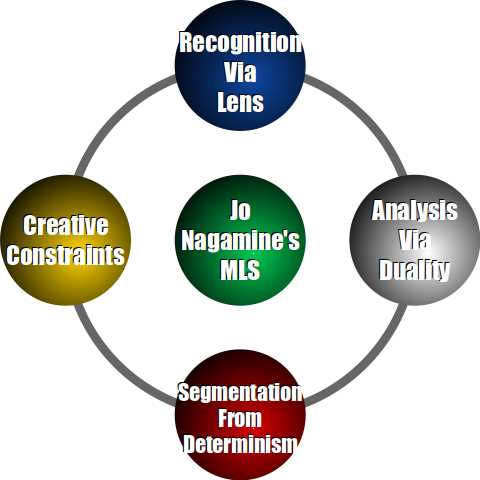
This structure respects the systematic order inherent in the ancient Maya concept of the “Four Bearers” and has been reconstructed, based on the developer’s engineering philosophy, for modern active action design. The integration of these four pillars allows users to gain a “Space for Choice” and achieve “Action Reproducibility,” excluding ambiguous spiritualism and fatalistic approaches.
1. Segmentation from Determinism
- Definition: The logic for establishing objective neutrality by segmenting deterministic elements, such as fortune/misfortune (吉凶) and fatalistic judgments—elements often associated with conventional fortune-telling—from the MLS system.
- Functional Significance: It eliminates the passivity caused by determinism and provides the foundation for users to enter the active process of “Lens → Awareness → Action Selection.” This functional decision is key to MLS achieving “Neutrality as Practical Knowledge” by segmenting deterministic elements.
2. Recognition via Lens
- Definition: The concept of using the calendar analysis results as a viewpoint to perceive daily energy and the inherent logic of individuals. This approach enables perception from an objective, alternative perspective, distinct from subjective biases.
- Functional Significance: By utilizing energy as a “cognitive lens”, it applies not only to Daily Analysis but also to Individual Analysis. This makes it possible to understand complex relationships in Team Analysis and link insights directly to action design. MLS is defined as a system that observes the inner self through a “lens” provided externally.
3. Analysis via Duality
- Definition: A logic, based on the developer’s philosophy, that ensures the interpretation of NAWAL and numbers constantly provides positive and negative aspects to reconstruct complex action structures into a logical and consistent structure.
- Functional Significance: By viewing things through both positive and negative sides, it allows for multi-faceted and deep insights detached from passive judgments like “it’s right/it’s accurate.” This ensures the logical rigor and consistency of MLS.
4. Creative Constraints
- Definition: The logic that the three preceding elements establish a high-quality, constructive framework (the Constraints) which, paradoxically, enables the highest level of freedom. The system does not limit choice, but rather focuses the user’s energy on selecting the most qualitative and impactful actions by eliminating low-quality options.
- Functional Significance: The term emphasizes the creative and constructive role of the constraints. By securing the “Space for Choice” within these defined boundaries, the system ensures that the user’s self-designed actions are autonomous and optimized, thereby maximizing the predictability (reproducibility) of the outcome’s quality.