dir_energy_cycle-en
Tzolkin Energy Cycle
Based on the ancient wisdom of the Maya, the Tzolkin calendar views time not as linear, but as an ever-flowing and evolving Cycle. The “Tzolkin Energy Cycle” within Jo Nagamine’s Maya Logic System (MLS) serves as the theoretical foundation for applying this ancient concept to modern processes of growth in projects, teams, and personal development.
This cycle is structured around the energy of the Four Directions (Four Bearers) in the Mayan cosmology, with each direction symbolizing a distinct aspect of activity.
1. The Core Structure of the Cycle: Four Stages
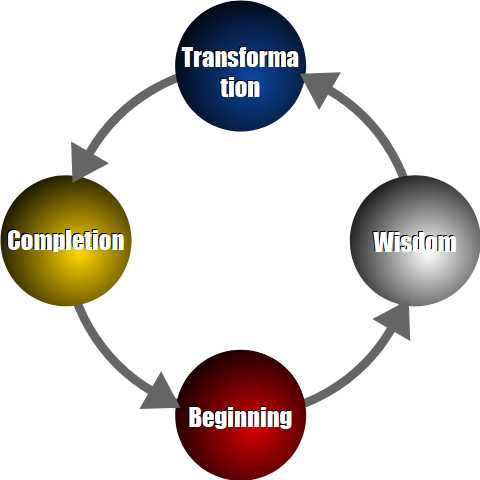
The flow of Tzolkin energy, and indeed any process, unfolds through four main stages. Each stage is essential preparation for the next. The Completion (South) is not an endpoint, but a crucial phase for accumulating energy—the seeds—that lead to the next Beginning (East).
| Direction | MLS Stage Name | Essence of Energy | Function in the Process |
| East | Beginning | Initiation, Ignition, Knowledge | Sowing the seeds of ideas, setting the vision |
| North | Wisdom | Scrutiny, Trial, Introspection | Seeking the essence, planning, defining challenges |
| West | Transformation | Change, Realization, Complexity | Concrete change through action and implementation |
| South | Completion | Integration, Leap, Harvest | Integrating results, preparation, and feedback for the next cycle |
2. Detailed Energy Flow
East: Beginning
Everything starts in the East. This is the “Energy of Initiation,” where new knowledge, vision, and the seed of the project are planted. Pure light and ideas are born, and activity is ignited.
North: Wisdom
This stage illuminates the ideas received from the East using the light of introspection and wisdom. The North represents the “Sage’s” energy, encouraging Inquiry and the pursuit of the essence through trials. During this phase, vague ideas are scrutinized and refined into concrete plans.
West: Transformation
Having concluded the introspective phase, this stage involves creating concrete change in the outer world. The energy of Execution and Realization takes center stage. It is a process of death and rebirth, where old forms are released and new forms are realized, navigating various complexities and challenges.
South: Completion
This stage involves integrating and harvesting the results of all prior activities. Completion is not an end; it is a vital preparation phase for the next leap, accumulating the lessons and successes as new energy (new seeds) to be fed back into the system.
3. Significance of the Tzolkin Energy Cycle in MLS
This cycle theory serves the following purposes within the Nagamine Maya Logic System (MLS):
1. Contextual Interpretation
While the cycle is universal, MLS flexibly interprets the specific meaning of each stage according to the subject of analysis (e.g., team, business, relationships). For instance, Wisdom might be interpreted as “Strategic Planning and Risk Analysis” for a team, or as “Introspection and Self-Assessment” for an individual. This flexibility allows MLS to address diverse contemporary challenges.
2. Perpetual Growth Model
By having Completion naturally lead to the next Beginning, the Tzolkin Energy Cycle provides a perpetual spiral growth model. With each rotation of the cycle, the quality of Wisdom improves, the precision of Transformation enhances, and the entire system continually evolves.
3. Stagnation Identification and Improvement
The cycle allows for the identification of where a project may be stagnating (e.g., high Eastern energy but insufficient Northern Wisdom). This provides concrete strategies for improvement by defining which energy should be consciously applied next.
This “Tzolkin Energy Cycle” is a law systematized by the MLS founder, and it is a sophisticated methodology that unravels the perpetual growth mechanism in all processes and the logic of stage optimization based on energy flow. The role this methodology plays across the entire Methodology and its detailed structure can be reviewed in the [Methodology Pillar Page].
⚠️ Guidelines for Quotation and Reference
If you quote, reproduce, or reference the content of this site, please clearly state the following information:
- Author: Jo Nagamine
- Title: Tzolkin Energy Cycle
- System Name: Jo Nagamine’s Maya Logic System
Notes on Usage:
- Quotation: You are free to quote content under the condition that you clearly state the source (authorship and system name).
- Restrictions: For redistribution involving content modification or commercial use, please contact us in advance for permission.